Hélène Audiffren: You began your collaborative practice in the early 2000s and have pursued a shared painting project for more than twenty-five years. The self-portrait that opens the exhibition at Carré d’Art – Musée d’art contemporain de Nîmes is a kind of painted riddle. It reads almost like a statement: is painting, above all, a conceptual object?
Tursic & Mille: We like the idea of “thinking through painting”. The self-portrait at the entrance does not say, “this is who we are”, but rather, “this is how our painting can operate”. With its long history, painting is not bound to a single style; it is a field of operations, tensions and possibilities. In that sense, yes, it is a statement, but a statement in action rather than a theoretical one.
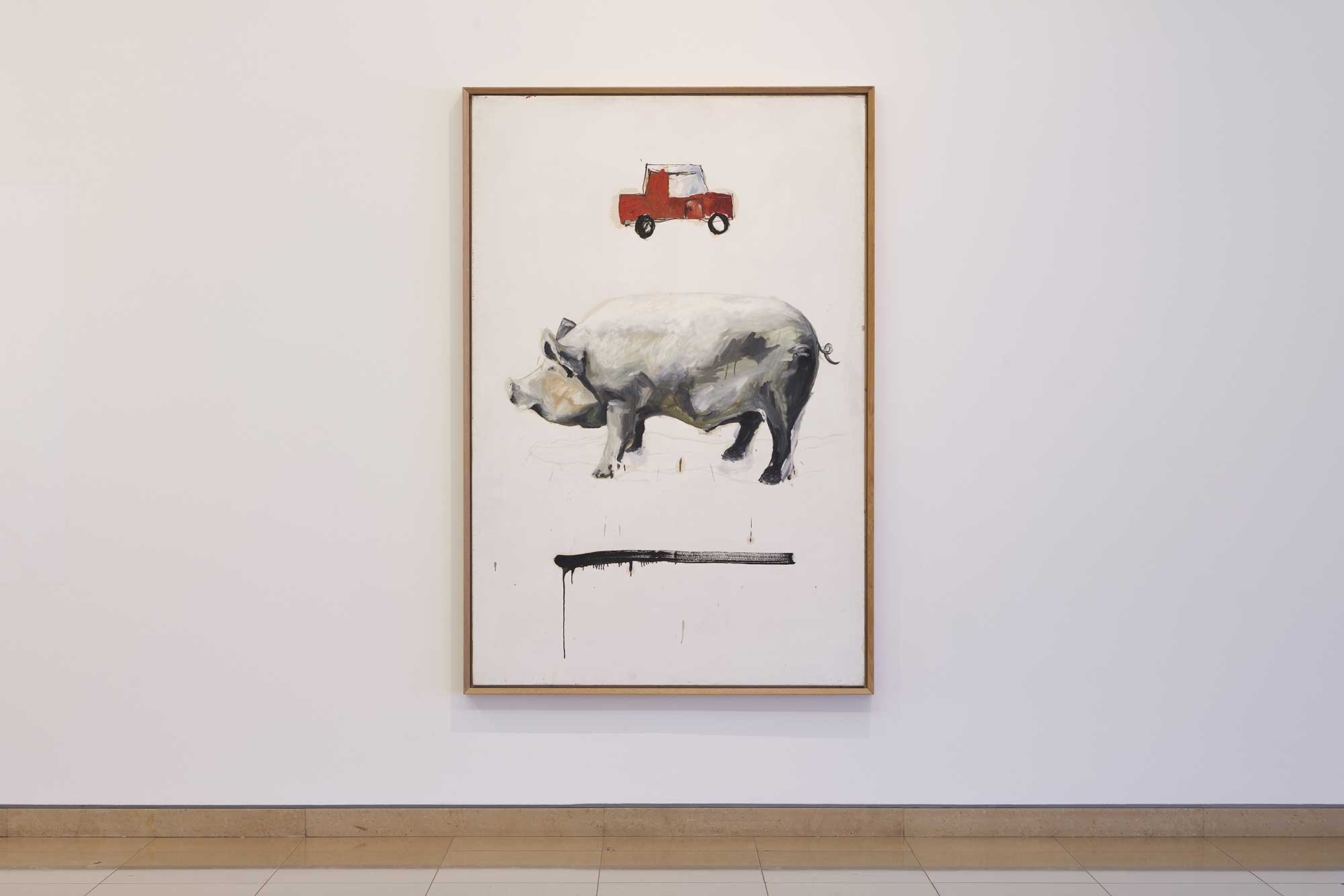
It is a self-portrait by Ida, painted in 1995, featuring a car (auto), a pig (porc) and a line (trait) — Auto-Porc-Trait, a visual pun on the French word autoportrait (self-portrait). Of course, we enjoyed playing with words together in the evenings, but this painting could only have been made by Ida. When you consider when it was painted, the apparent joke takes on a much deeper meaning. It becomes more than a self-portrait, more than a ridiculous, glorious or narcissistic self-representation.
“Finding a style in painting would be like slipping into a pair of slippers.”
H.A.: The execution is both highly crafted and remarkably accomplished. A car rendered like a child’s drawing, a highly realistic pig, a line made with a single brushstroke — doesn’t this self-portrait also suggest that formal solutions can be adapted to the needs of each individual painting?
T&M: Absolutely. Why confine ourselves to a stable, instantly recognisable visual signature? Painting is a matter of decisions. Each painting calls for its own resolution, its own mode of execution, its own internal grammar and syntax. Finding a style in painting would be like settling into a comfortable pair of slippers.
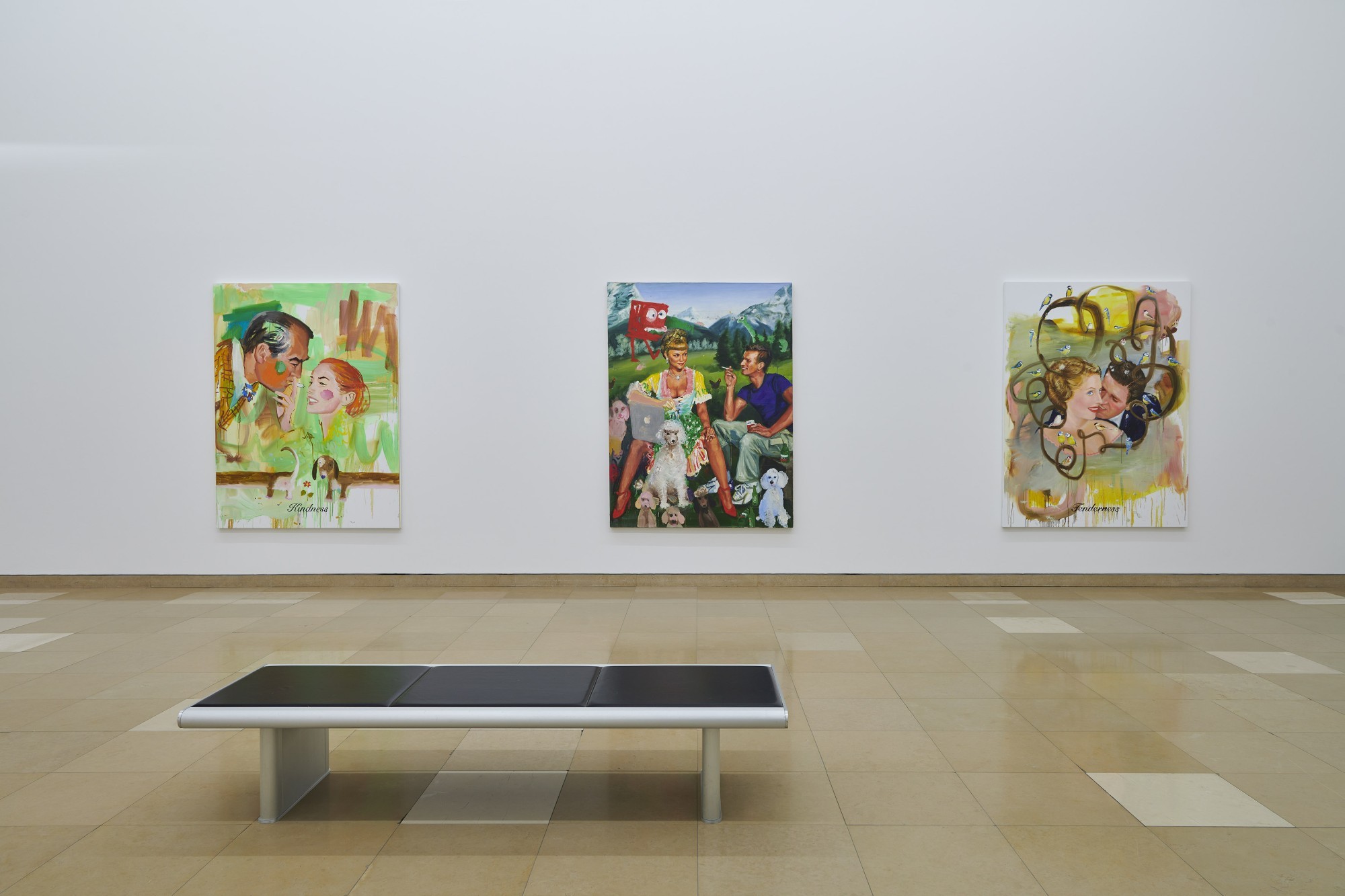
H.A.: There is also the question of humour. A series of slightly sentimental couple portraits reworks post-war advertisements drawn from a white, patriarchal visual culture, punctuated by pictorial incongruities. Is this, with a touch of irony, a way of questioning dominant culture and the boundary between good and bad taste?
T&M: The boundary between good and bad taste is of little interest to us; it is sometimes too thin to be meaningfully perceived. What interests us is how certain images generate consensus, and how painting can introduce dissonance into that consensus. Because we are naturally suspicious of images, humour acts more as a tool for deactivation.
These advertising images are already loaded with emotional, moral and social norms. In this series, the source images are generally advertisements for cigarettes or alcohol, dating from a time when smoking was supposedly good for your health. The aim was not to caricature them, but to subtly shift the way they operate and disrupt their effectiveness. They are highly performative images, very close to the visual language of propaganda or Socialist Realism.
H.A.: In the same space, you can bring together an abstract painting, small floral works, landscapes, portraits and large black flowers that have been cut out and charred. Is painting really a matter of style or subject matter? Could it be all of these things at once?
T&M: Yes — life, in a way. :) The idea is not to bring everything together, but to allow forms that would not normally coexist to inhabit the same space. Abstraction, figuration, different iconographic registers: these are visual regimes that rub against one another. Painting is therefore neither a style nor a collection of subjects; it is a living, cannibalistic entity that develops empirically through space and time.
This logic is already apparent upon entering the hall of Carré d’Art, where Framed Landscape is presented in an entirely new form. The landscape, painted directly onto the panels that serve as studio walls and mounted on a wooden structure reminiscent of a billboard, shifts from the contemplative realm of the picture to that of the exhibited object — public, almost promotional. Painting becomes a signal: it displays itself, propagates itself, while simultaneously revealing the seeds of its own destruction.
This logic of painting’s “self-propaganda” — where representation illustrates nothing beyond its own circulation and fragmentation — is deliberately undermined by the presence of the Bichon, an unexpected motif that acts as a disruptive element, interfering with the image and deflating any sense of pathos. Together, the works create an initial short circuit between seriousness and humour, landscape and object, painting and display device. From the outset, they establish the rules of a game in which painting contradicts itself as much as it asserts itself, as though the very conditions of its existence might emerge from its own disintegration.
H.A.: And then there are the barbouilles — the offset plates covered in paint, the lumps of pure pigment, the girl with her hands dipped in paint. In the end, is the question of figuration versus abstraction beside the point?
T&M: Indeed. For us, that opposition makes no sense. Choosing to become a painter means opening yourself to all the possibilities inherent in the medium. It is a risk, a search for freedom. The barbouilles, the offset plates and the accumulations of paint are the very embodiment of work itself. They show painting in its material rawness, before it becomes a picture, or after it has ceased to be one. These are zones where painting manifests itself as matter and as time, with no obligation to represent anything — no obligation at all.
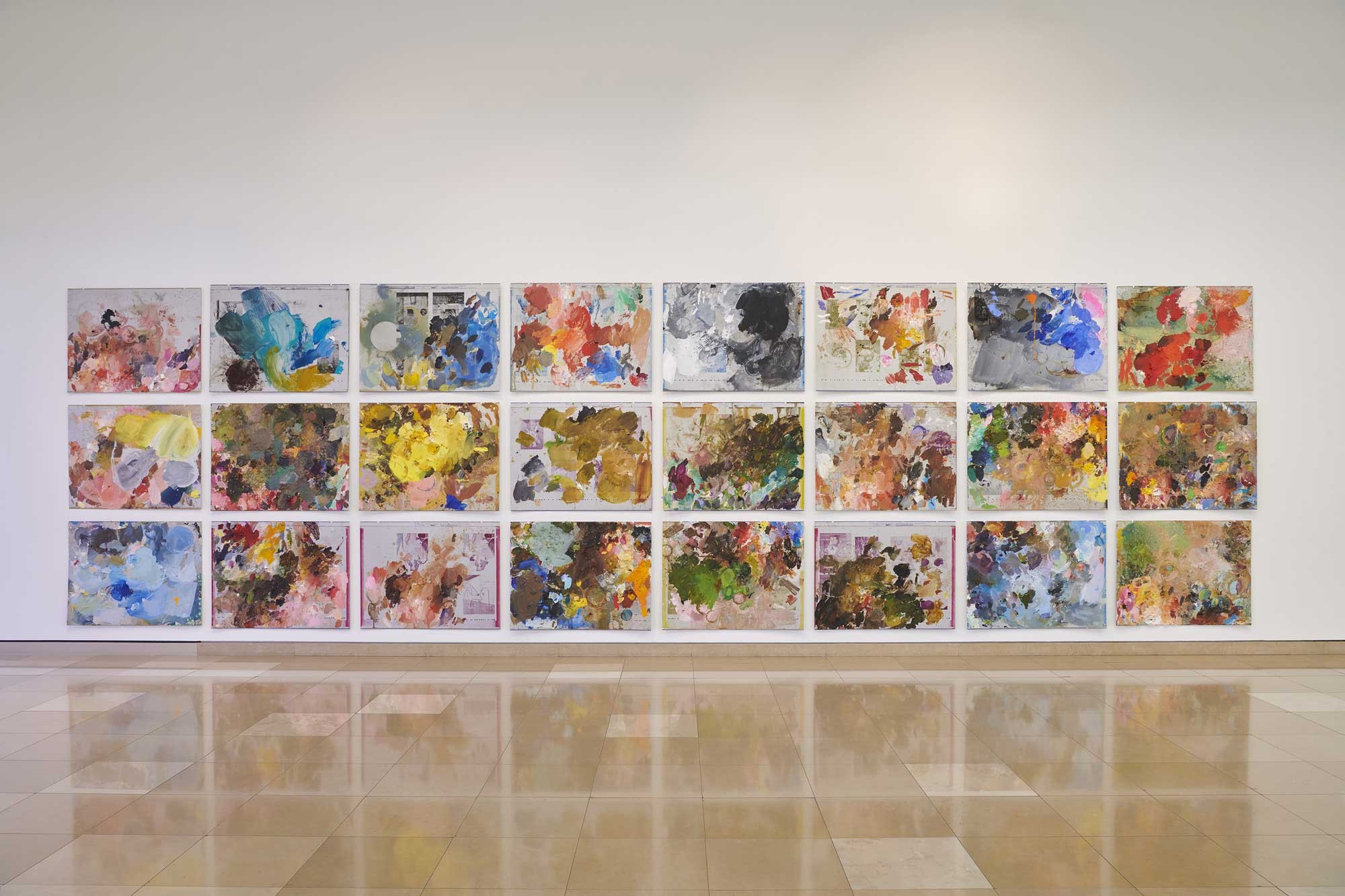
H.A.: A table on which all the paint residues from the studio have been accumulating for years bears the title of the famous myth of Sisyphus. Does this suggest that painting is a process of perpetual renewal?
T&M: Here we enter the obscene side of the work. Obscene in the original Latin sense: ob scaena — “off stage”, outside the scene. Much like the barbouilles, which piled up in the studio without any prior intention, purpose, or even the idea that they might one day be shown. We have always had a place — a bucket, cardboard boxes, and eventually a wooden board — where we deposit excess paint, scrapings and the remnants of erasures.
In truth, we find it difficult to throw paint away. The material itself has something resistant about it. At first, it was a purely practical “object”, the process in its raw state. Over time, it became a heap — a physical accumulation of colours with an almost organic appearance, but also a heap of possible meanings.
Perhaps this is the existential, almost metaphysical dimension of painting: a practice without resolution, without any possible conclusion. The reference to Sisyphus points to an activity that continues without any promise of completion. It is the embodiment of making itself.
H.A.: In your various full-length portraits of the tragic pin-up Bettie Page, you weave in references to art history, from Gerhard Richter to Kazimir Malevich and Christopher Wool. Elsewhere, a young woman with an ecstatic gaze, copied from a painting by Jean-Baptiste Greuze, receives a streak of paint seemingly fallen from the sky across her face. Are these works intended as tributes, affirmations of artistic lineage, or perhaps ways of shifting our perspective on a certain history of painting?
T.&M.: As Asger Jorn once said, “painting is painting’s favourite food.”
The first Bettie paintings formed a triptych: three identical figures derived from the same photograph, almost like a reinterpretation of The Three Graces. Here, variation is not physical but conceptual; it is repetition itself that generates meaning. Differences are displaced onto pictorial accidents, a border collie figurine frozen in three different poses, and the paintings appearing in the background (from Malevich to Wool, from Prince to Richter, from Picasso to Mondrian). Perhaps it is a way of painting painting itself, in a wide range of positions.
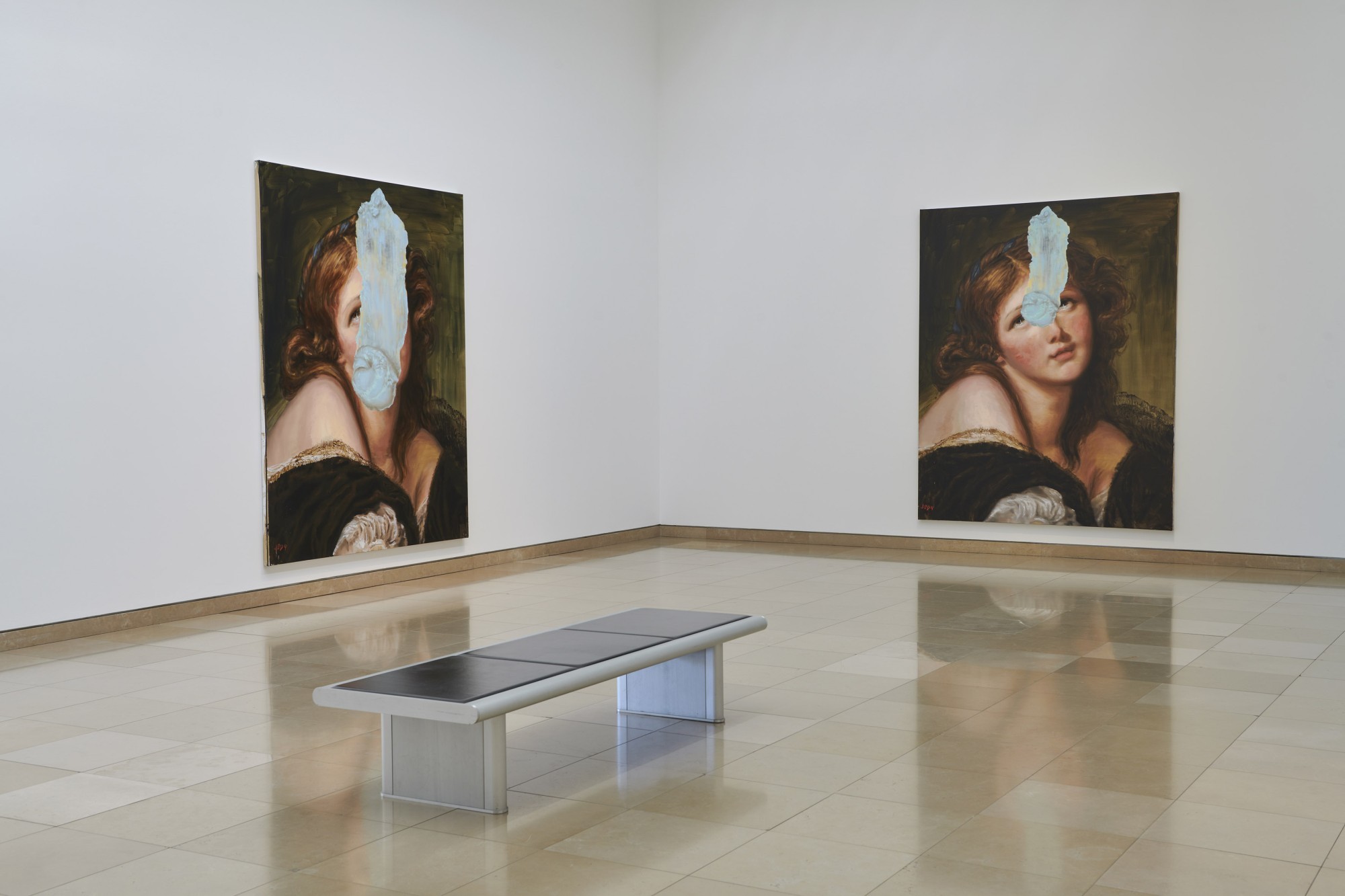
In the Nîmes exhibition, in what we call the “accident room”, three large-scale versions of a detail from a Greuze painting are presented — once again, three times over. Three minimal variations, following the same protocol; only the size of a blue paint stain changes from one canvas to the next.
In Jean-Baptiste Greuze’s work, the face is the locus of moral and emotional meaning. The stain means nothing. It is a material element, not a sign. It introduces something that does not speak where everything was designed to speak. It simply prevents the face from producing what it is expected to produce.
What was once the semantic centre becomes, through the stain, a pictorial event. Painting ceases to be an image to be read and becomes a surface to be experienced. Identification is no longer possible, emotional interpretation is suspended, and the face itself is held in suspension.
From that point on, the history of painting is no longer a sacred inheritance but an operational material. Repetition is crucial here: the first stain may surprise, the second compels comparison, and the third neutralises any sense of spectacle. The stain ceases to be an expressive gesture and becomes a parameter, a piece of data.
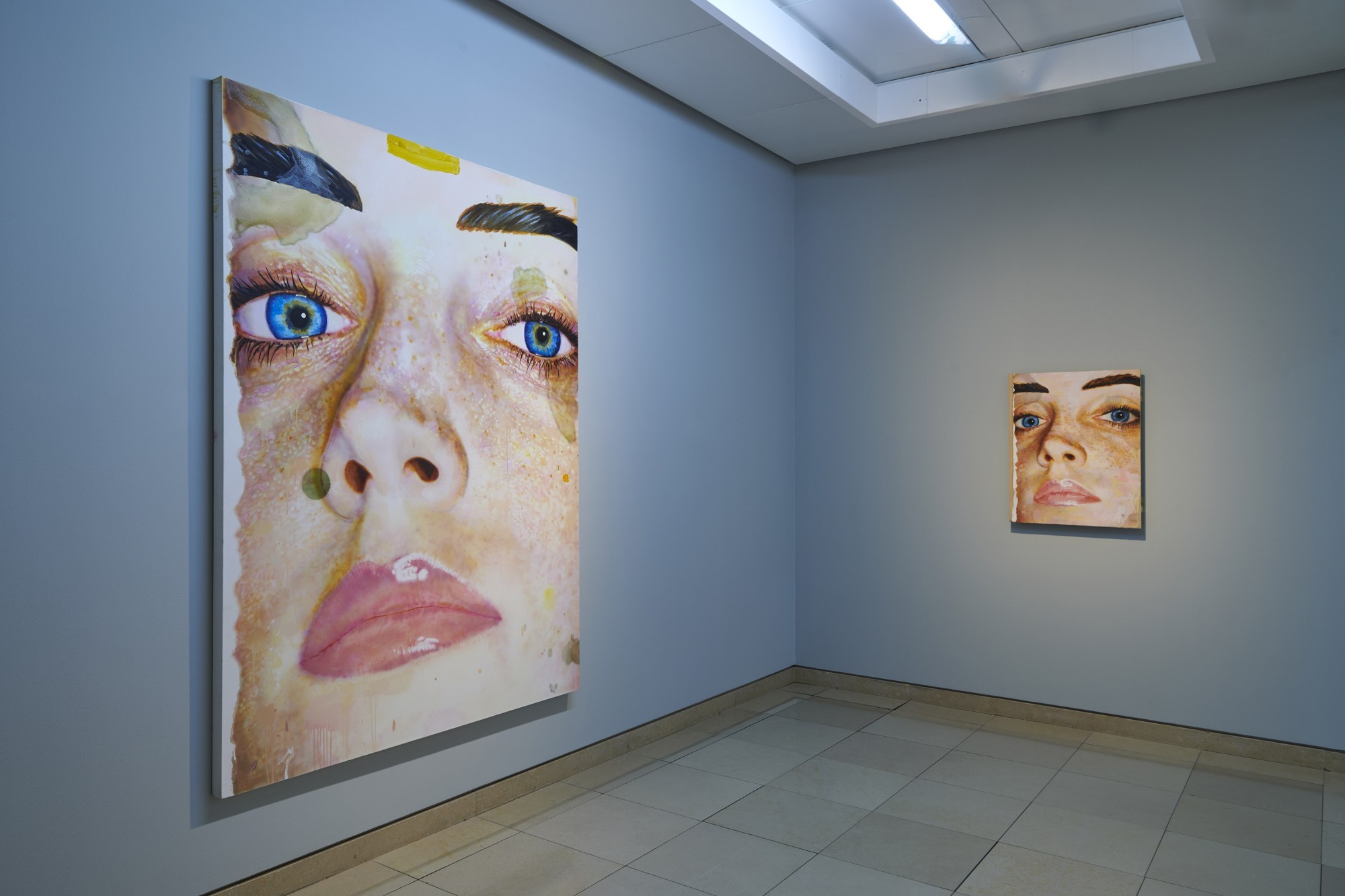
H.A.: I invited you in 2008 to create an exhibition at the Musée régional d’art contemporain in Sérignan. Since then, some of your source images have changed. Along the way, you moved away from pornographic imagery, 3D images, optical effects and inkjet prints. Other images, however, have remained. The Face, a page torn from a magazine, has been revisited from the very beginning as a still life in an extremely slow state of decay. What is at stake in abandonment, revisiting and repetition?
T.&M.: First of all, it is a pleasure to be working together again, and especially here at Carré d’Art. It has always been one of our favourite museums in France, because of its architecture of course, but also because of the artists who have exhibited here — a large part of our imaginary family: Polke, Merz, Gasiorowski, Oehlen, Baldessari...
We like to think of painting as a large house in which, over time, new doors are opened. Some lead to other rooms, which in turn open onto further doors. None of them is ever completely closed. It is making itself, and the passage of time, that prompts us to make again, make differently, make once more. There is never really any abandonment. Certain things happen when they need to happen; the door remains open, but the work has to feel relevant at the moment we return to it. Some ideas emerge at a particular time and then simply wait.
The inkjet prints, for example, were our first attempt to make use of the barbouilles accumulating in the studio. They were enlarged, out-of-scale reproductions of those paint smears printed onto canvas. That particular experiment came to an end, but the barbouilles themselves did not.
The use of pornographic imagery corresponded to the emergence of the internet and an unprecedented flood of images, but also to a period when painting had relatively little visibility in France. We wanted to make paintings that were impossible to ignore. We used source images that were both intimately and politically tied to their time, while still engaging with the classical categories of painting: portraits, nudes, genre scenes — one could almost speak of geometric painting at times.
Over time, obscenity became more conceptual: it shifted towards what lies outside the frame, towards the very making of painting itself. The Face is a good example of this. By simply changing perspective, a portrait became a still life and then, almost, a portrait once again — a paper Dorian Gray. Repetition puts the image to the test of time; what endures is never quite the same.
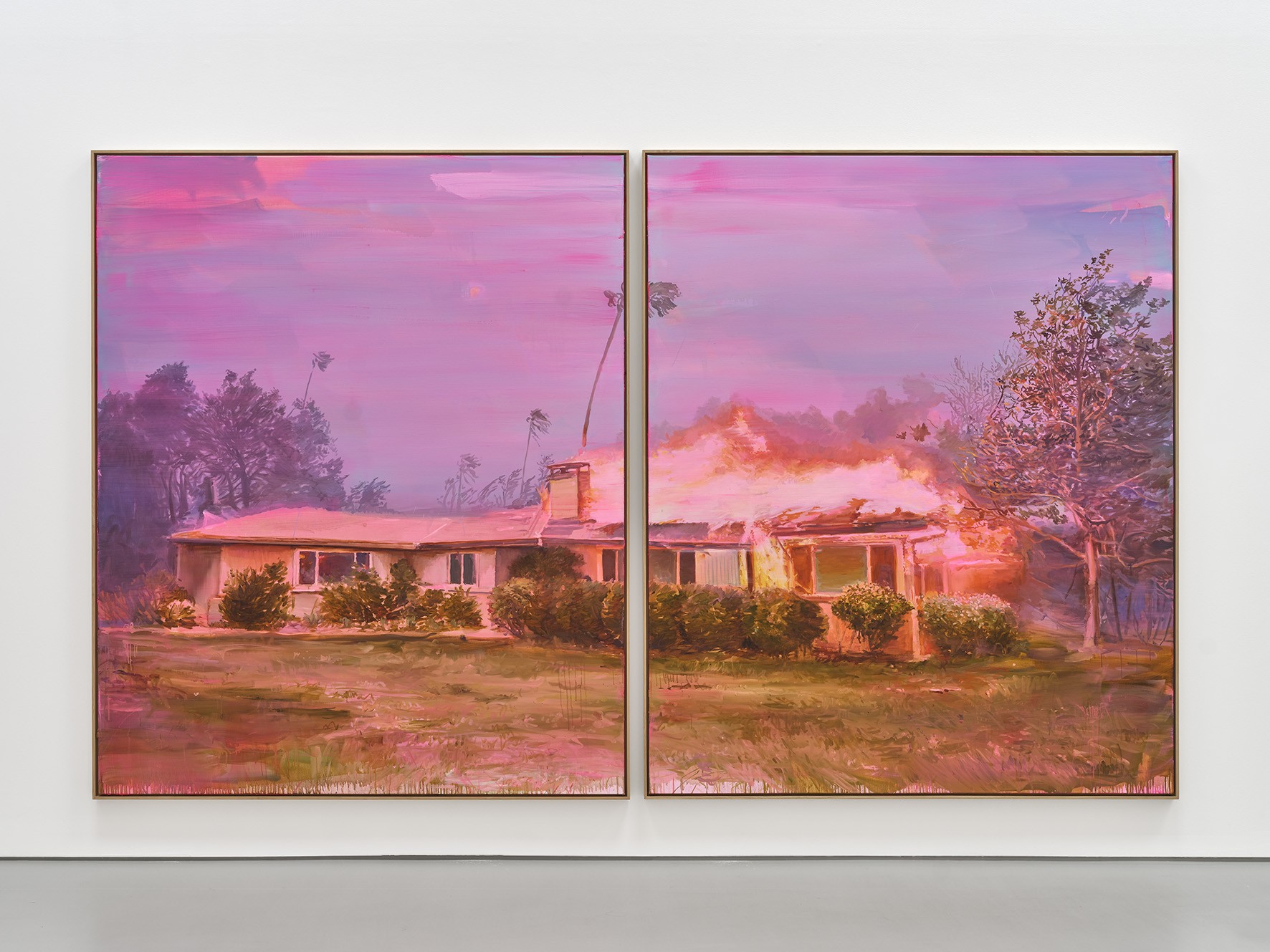
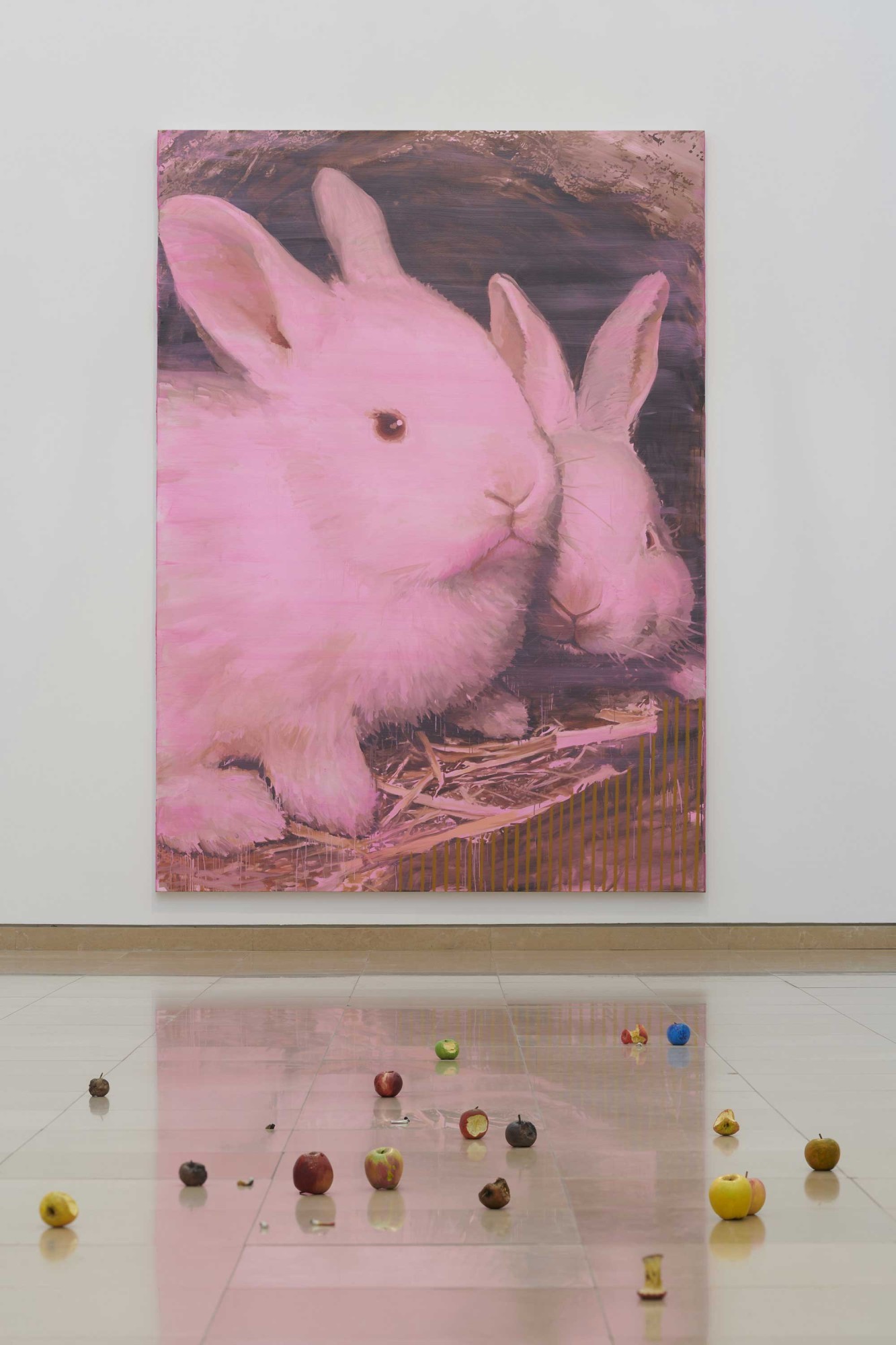
H.A.: In your recent Lavis en rose series, landscapes, a nude, an eclipse, small white rabbits, a wildfire and a bombing scene all coexist. The wash technique creates depth while, at the same time, establishing a sense of distance. Don’t these pink-tinted images become even stranger and more troubled?
T.&M.: Lavis en rose is a promise of happiness distilled into a single pictorial gesture. The wash plays a deliberately ambiguous role: it creates depth while maintaining distance. Pink acts as an almost deceptive emotional filter. It dramatizes nothing; it suspends time, neutralising without anaesthetising.
The wash places all images on the same level, whether they are violent, historical or cosmological. The pink room at Carré d’Art functions as a continuous flow in which the eye moves from one painting to another, sometimes drawn in, sometimes slowed down, stumbling over internal dissonances. In this sense, it can evoke the contemporary circulation of images — their endless succession without hierarchy or resolution.
Yet where such a flow could become little more than a rabbit hole, painting introduces something irreducible. The time of painting — its density, its material presence, its slowness — resists any form of immediate consumption. The wash does not soothe; it neutralises the weight of pathos. It makes these scenes stranger, perhaps even more unsettling, because they contain something that resists interpretation, as though painting itself were refusing any immediate reading.
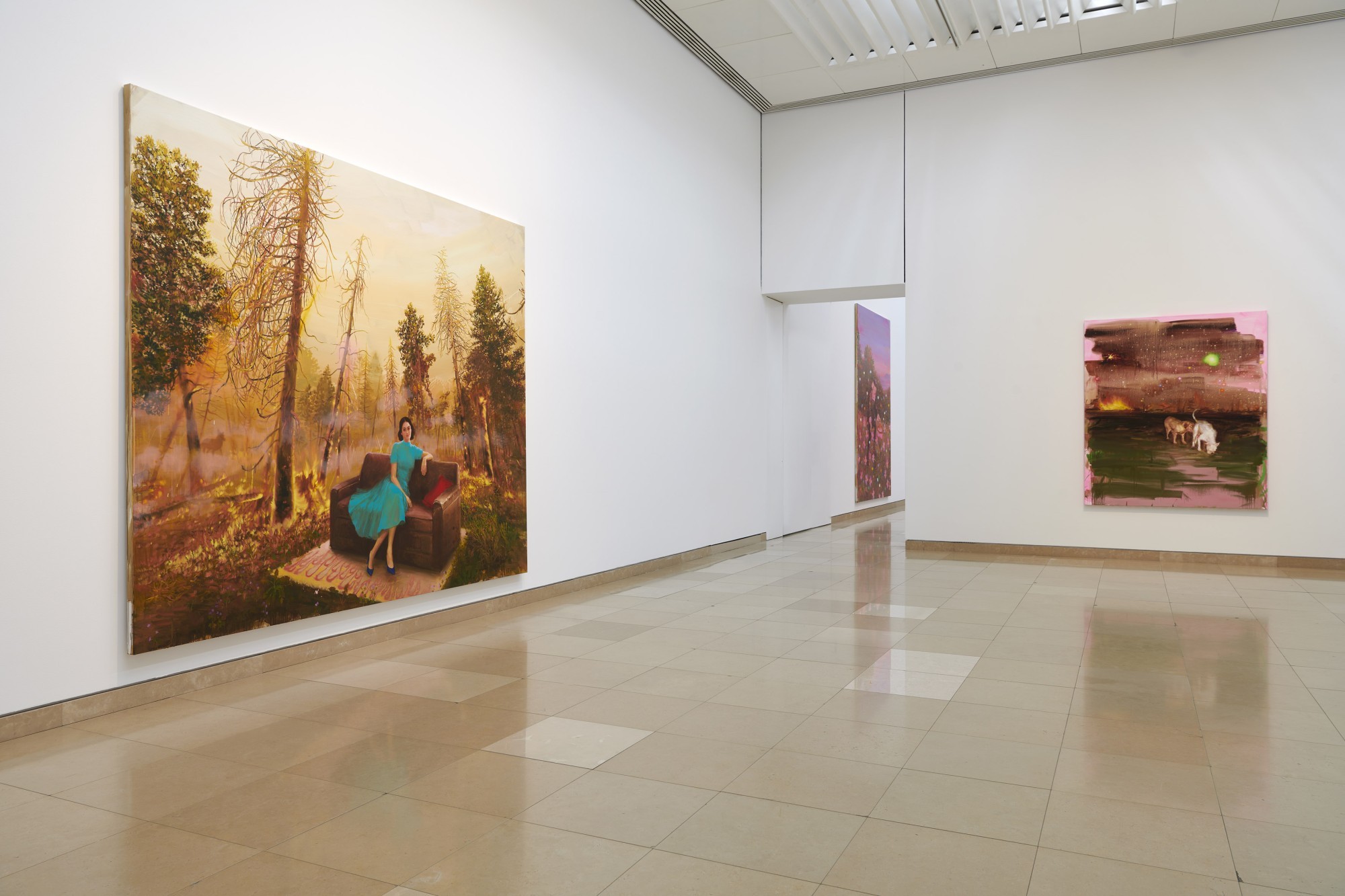
H.A.: A woman sits on a sofa, looking directly at us, her back turned to a burning forest. Is this a tragic conclusion, a way of portraying the absurdity of the world?
T.&M.: This painting is located in the final room of the exhibition, after the flow of the pink room, almost as a moment of settling and reflection. The dissonance does not arise from the catastrophe itself, but from the strange calm that inhabits the scene — the absence of urgency, the disconnect between the violence of the landscape and the figure’s posture, as though the fire had simply become part of the scenery.
It belongs to a group of paintings in which catastrophe no longer functions as an event, but as a latent, almost metaphysical condition. A house is burning. Dogs continue their conversation beneath a starry sky. A human figure is placed within a world that remains indifferent to them. And then there is this woman, comfortably seated, looking back at us.
These situations do not tell a story. They describe different possible ways of existing within an unstable world, marked by a disconnection between event and reaction. Painting preserves this intermediate state, this in-between, where nothing entirely collapses, yet everything somehow continues regardless.
Dissonances à géométries variables, by Tursic & Mille, until 11 October 2026 at Carré d’Art – Musée d’art contemporain, Nîmes